

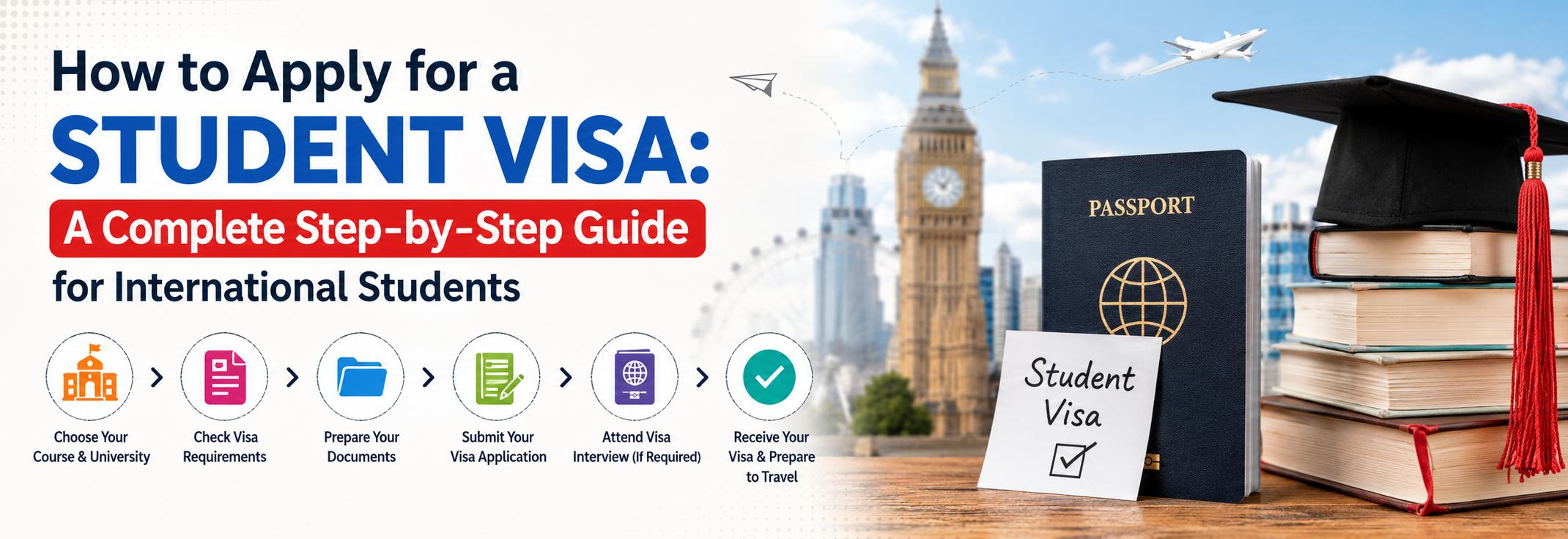
How to Apply for a Student Visa: A Complete Step-by-Step Guide for International Students
Introduction
Studying abroad is a dream for thousands of students who want to access world-class education, gain international exposure, and build successful global careers. Whether you plan to study in the UK, Australia, Canada, the USA, Ireland, New Zealand, or any other popular destination, obtaining a student visa is one of the most important steps in your study abroad journey.
A student visa is an official authorization issued by a country’s immigration department that allows international students to enter, stay, and study legally in that country. While the visa application process may seem complex, proper planning and guidance can make it smooth and stress-free.
In this comprehensive guide, we’ll explain everything you need to know about how to apply for a student visa, including eligibility requirements, documentation, application procedures, interview preparation, common mistakes to avoid, and expert tips to increase your visa approval chances.
What Is a Student Visa?
A student visa is a legal document or endorsement issued by a country’s government that permits foreign nationals to pursue education at an approved institution.
Each country has its own visa category, requirements, and application process. Some common examples include:
- UK Student Visa
- Australian Student Visa (Subclass 500)
- Canada Study Permit
- USA F-1 Student Visa
- Ireland Student Visa
- New Zealand Student Visa
Your visa determines:
- Duration of stay
- Work rights during studies
- Post-study work opportunities
- Travel permissions
- Compliance requirements
Why Is a Student Visa Important?
Without a valid student visa, international students cannot legally study abroad.
A student visa allows you to:
- Enroll in an approved educational institution
- Enter and stay in the destination country
- Work part-time (where permitted)
- Access post-study work opportunities
- Travel internationally during your studies
- Comply with immigration laws
Failure to maintain visa conditions may result in visa cancellation or future immigration complications.
Step 1: Choose Your Study Destination
Before applying for a student visa, you must first decide where you want to study.
Popular study destinations include:
United Kingdom
Benefits:
- Globally recognized universities
- One-year master’s programs
- Graduate Route Visa
- Excellent career opportunities
Australia
Benefits:
- High-quality education
- Student-friendly immigration policies
- Work opportunities during studies
- Post-study work visas
Canada
Benefits:
- Affordable education
- Strong immigration pathways
- High quality of life
- Excellent employment opportunities
USA
Benefits:
- Top-ranked universities
- Extensive course options
- Research opportunities
- Global networking
Ireland
Benefits:
- Growing job market
- Strong technology sector
- Post-study work opportunities
Step 2: Secure Admission from a Recognized Institution
The next step is obtaining admission to a recognized university, college, or educational institution.
You typically need:
- Academic transcripts
- English language proficiency scores
- Statement of Purpose (SOP)
- Letters of Recommendation (LOR)
- Resume/CV
- Passport copy
Once accepted, you’ll receive an offer letter or confirmation of enrollment.
This document is essential for your student visa application.
Step 3: Understand Visa Requirements
Each country has different visa requirements, but most student visa applications require proof of:
- Admission confirmation
- Financial capability
- English language proficiency
- Health insurance
- Genuine study intentions
- Valid passport
Research the specific requirements of your chosen destination carefully.
Step 4: Prepare Financial Documents
One of the most important parts of your visa application is proving that you can financially support yourself.
Immigration authorities want assurance that you can cover:
- Tuition fees
- Living expenses
- Accommodation
- Travel expenses
- Health insurance
Common financial documents include:
- Bank statements
- Fixed deposits
- Education loan sanction letters
- Income tax returns
- Salary slips
- Sponsorship letters
Financial requirements vary depending on the country and duration of study.
Step 5: Meet English Language Requirements
Many countries require proof of English proficiency.
Accepted tests often include:
- IELTS
- PTE Academic
- TOEFL
- Duolingo English Test
- Cambridge English
Minimum score requirements depend on:
- Institution
- Course level
- Country regulations
Some universities may waive English test requirements under specific conditions.
Step 6: Obtain Health Insurance
Several countries require international students to maintain health insurance.
Examples include:
Australia
Overseas Student Health Cover (OSHC) is mandatory.
Canada
Many provinces require health insurance coverage.
United Kingdom
Students generally pay the Immigration Health Surcharge (IHS).
New Zealand
Health insurance is usually compulsory.
Having adequate health coverage protects students from unexpected medical expenses.
Step 7: Gather Required Documents
Although requirements differ by country, students generally need:
Personal Documents
- Valid passport
- Passport-sized photographs
- Birth certificate (if applicable)
Academic Documents
- Mark sheets
- Degree certificates
- Offer letter
- Enrollment confirmation
Financial Documents
- Bank statements
- Sponsorship documents
- Loan approvals
English Language Documents
- IELTS scorecard
- PTE results
- TOEFL results
Additional Documents
- Statement of Purpose
- Visa application form
- Health insurance documents
- Police clearance certificate (if required)
Organize all documents carefully to avoid delays.
Step 8: Complete the Visa Application Form
Most countries now offer online visa applications.
When completing the form:
- Provide accurate information
- Match details exactly with your passport
- Double-check spelling
- Review all dates carefully
Common information requested includes:
- Personal details
- Educational history
- Family information
- Travel history
- Financial information
- Course details
Even minor mistakes can lead to processing delays.
Step 9: Pay the Visa Application Fee
Every country charges a visa application fee.
The amount varies depending on:
- Country
- Visa category
- Application type
Keep payment receipts safely as they may be required during the process.
Step 10: Schedule Biometrics Appointment
Many countries require biometric verification.
Biometrics may include:
- Fingerprints
- Digital photograph
- Signature
Appointments are usually conducted at authorized visa application centers.
Students should arrive on time and carry all required documents.
Step 11: Attend a Visa Interview (If Required)
Some countries require students to attend visa interviews.
The USA, for example, generally requires an interview at a consulate or embassy.
Common visa interview questions include:
Why do you want to study in this country?
Explain your academic goals and reasons for choosing the destination.
Why did you choose this university?
Demonstrate that you researched the institution and program.
Who is sponsoring your education?
Provide clear financial details.
What are your future career plans?
Show genuine educational and professional intentions.
Do you plan to return to your home country?
Answer honestly while explaining your long-term career goals.
Tips for a Successful Visa Interview
- Dress professionally
- Arrive early
- Speak confidently
- Maintain eye contact
- Be honest
- Provide concise answers
- Carry supporting documents
Confidence and preparation play a major role in visa interview success.
Step 12: Track Your Application
After submission, most immigration authorities allow students to track application status online.
Possible statuses include:
- Submitted
- Under Review
- Additional Documents Requested
- Approved
- Refused
Respond promptly if additional documents are requested.
Step 13: Receive Visa Decision
Once approved, you’ll receive your student visa or visa approval letter.
Verify:
- Name spelling
- Passport number
- Visa validity dates
- Study conditions
Contact immigration authorities immediately if errors are found.
Common Reasons for Student Visa Rejection
Visa refusals can occur for several reasons.
Common causes include:
Insufficient Financial Evidence
Failure to prove adequate funding is a major reason for rejection.
Incomplete Documentation
Missing documents often delay or negatively impact applications.
False Information
Providing inaccurate information can lead to refusal and future bans.
Weak Statement of Purpose
A poorly written SOP may raise concerns about genuine study intentions.
Poor Visa Interview Performance
Unclear answers can affect approval chances.
Academic Concerns
Large education gaps or weak academic records may require additional explanation.
How to Increase Your Student Visa Approval Chances
Apply Early
Start the process several months before your course begins.
Maintain Accurate Documentation
Ensure consistency across all documents.
Demonstrate Genuine Intentions
Clearly explain your academic and career goals.
Show Strong Financial Support
Provide complete and transparent financial evidence.
Seek Professional Guidance
Working with experienced study abroad consultants can significantly improve your chances of success.
Student Visa Processing Time
Processing times vary by country and season.
Typical processing timelines:
| Country | Approximate Processing Time |
|---|---|
| UK | 3–8 Weeks |
| Australia | 4–12 Weeks |
| Canada | 4–12 Weeks |
| USA | Depends on interview availability |
| Ireland | 4–8 Weeks |
| New Zealand | 4–8 Weeks |
Students should apply as early as possible to avoid last-minute complications.
After Receiving Your Student Visa
Once your visa is approved:
Book Accommodation
Arrange housing before arrival.
Book Flights
Reserve flights early for better pricing.
Attend Pre-Departure Sessions
Learn about:
- Immigration procedures
- Local culture
- Transportation
- Banking
- Healthcare
Prepare Essential Documents
Carry:
- Passport
- Visa approval letter
- Offer letter
- Financial documents
- Accommodation details
Why Choose Professional Student Visa Assistance?
Many students struggle with:
- Documentation
- SOP preparation
- Financial requirements
- Visa interviews
- Application timelines
Professional consultants help reduce errors and improve approval chances.
Benefits include:
- Personalized counseling
- University selection assistance
- Documentation support
- Visa filing guidance
- Interview preparation
- Pre-departure assistance
Final Thoughts
Applying for a student visa is a crucial step toward achieving your international education goals. While the process may appear challenging, careful planning, accurate documentation, and timely action can make it straightforward and successful.
Whether you plan to study in the UK, Australia, Canada, the USA, Ireland, or New Zealand, understanding the visa process and meeting all requirements will significantly improve your chances of approval.
At MDOEC (Multi Destination Overseas Education Consultants), we provide end-to-end support for university admissions, visa applications, scholarships, education loans, accommodation guidance, and pre-departure assistance. Our experienced counselors help students navigate every stage of their study abroad journey with confidence.
If you’re planning to study abroad, connect with MDOEC today and take the first step toward a successful international education and global career.
FAQs About Student Visa Applications
1. What documents are required to apply for a student visa?
Most student visa applications require a valid passport, university offer letter, proof of financial support, academic transcripts, English language test scores (IELTS, PTE, TOEFL, etc.), passport-sized photographs, and health insurance documents.
2. How much bank balance is required for a student visa?
The required bank balance depends on the country and your course duration. Generally, you must show sufficient funds to cover tuition fees, living expenses, accommodation, and travel costs.
3. How long does it take to process a student visa?
Student visa processing times vary by country. On average, it can take anywhere from 3 to 12 weeks, depending on application volume and document verification requirements.
4. Can I work while studying on a student visa?
Many countries, including the UK, Australia, Canada, and New Zealand, allow international students to work part-time during their studies, subject to visa conditions and work-hour limits.
5. Is an IELTS score mandatory for a student visa?
Not always. Some universities and countries may accept alternative English proficiency tests or offer waivers through a Medium of Instruction (MOI) certificate, depending on eligibility.
6. What are the common reasons for student visa rejection?
Common reasons include insufficient financial proof, incomplete documentation, inaccurate information, weak Statement of Purpose (SOP), poor visa interview performance, and failure to meet visa requirements.
7. Can I apply for a student visa without an admission offer?
No. In most cases, you must first receive an offer letter or confirmation of enrollment from a recognized educational institution before applying for a student visa.
8. What happens if my student visa application is rejected?
If your visa is refused, you may be able to reapply after addressing the reasons for rejection. Some countries also offer an appeal or review process depending on the circumstances.
9. Do I need health insurance for a student visa?
Yes, many countries require international students to have health insurance coverage. Requirements vary by destination, and proof of insurance may be required during the visa application process.
10. When should I apply for my student visa?
It is recommended to apply at least 3–6 months before your course start date to allow enough time for document preparation, processing, biometrics, interviews, and travel arrangements.