

Study Masters in Singapore: Perks, Universities, Cost, & More (2026 Guide)
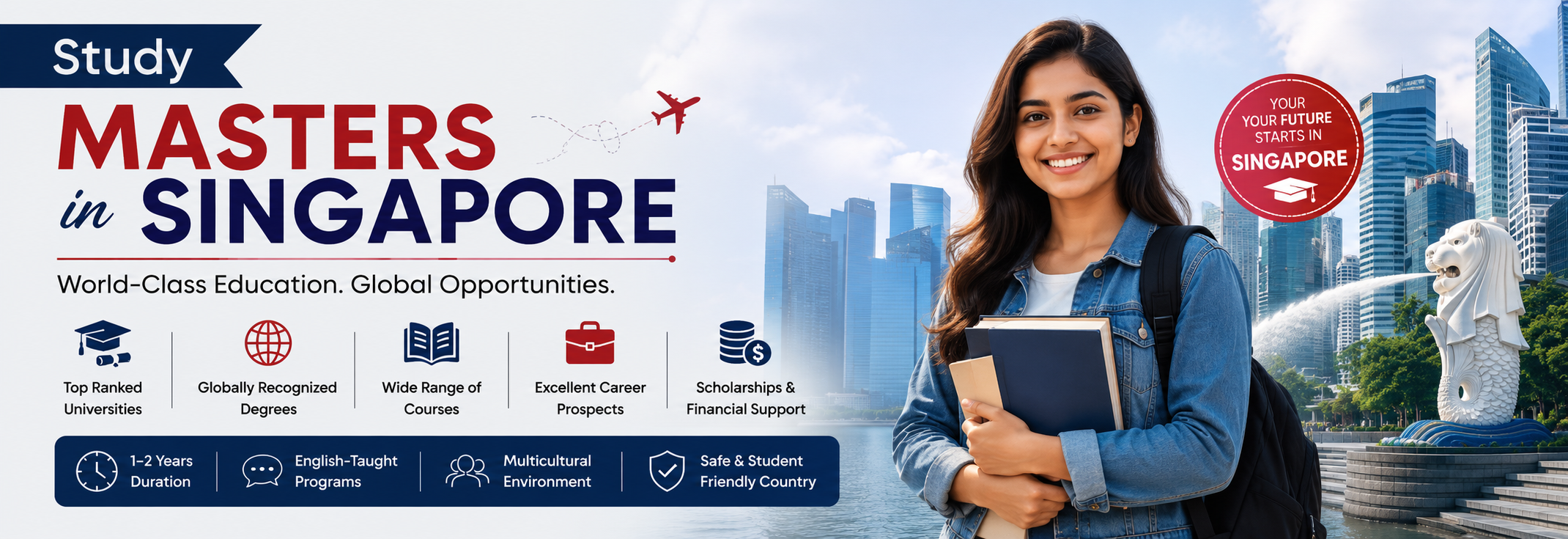
Singapore has rapidly emerged as one of the most sought-after destinations for higher education, especially for international students looking to pursue a master’s degree. Known for its world-class universities, globally recognised qualifications, cutting-edge research, and strong employment market, Singapore offers the perfect blend of academic excellence and career opportunities.
For Indian students, Singapore is particularly attractive due to its close proximity, multicultural environment, high standard of living, and comparatively lower tuition fees than countries like the USA or the UK. The country’s strategic location in Asia also makes it a global business hub, providing excellent networking opportunities and access to multinational companies.
Whether you’re planning to pursue an MBA, Data Science, Artificial Intelligence, Engineering, Finance, Healthcare, or Computer Science, Singapore offers a wide range of specialised master’s programmes designed to meet global industry demands.
In this comprehensive guide, we’ll cover everything you need to know about studying a Masters in Singapore—from the top universities and popular courses to tuition fees, scholarships, living costs, career prospects, and much more.
Table of Contents
- Study Masters in Singapore – Highlights
- Benefits of Studying Masters in Singapore
- Top Universities and Courses to Study Masters in Singapore
- Cost to Study Masters in Singapore
- Scholarships to Study Masters in Singapore
- Part-Time Work Rights for International Students Pursuing Masters in Singapore
- Global Career Prospects After Studying Masters in Singapore
- FAQs
Study Masters in Singapore – Highlights
| Particular | Details |
|---|---|
| Country | Singapore |
| Degree | Masters (Postgraduate) |
| Duration | 1–2 Years |
| Popular Intakes | August & January |
| Average Tuition Fees | SGD 25,000–60,000 |
| Language of Instruction | English |
| IELTS Requirement | Usually 6.5–7.0 |
| TOEFL Accepted | Yes |
| GRE/GMAT | Required for selected programmes |
| Part-Time Work | Allowed (subject to university & visa conditions) |
| Post-Study Opportunities | Excellent across Finance, IT, Engineering & Healthcare |
| Top Universities | NUS, NTU, SMU, SUTD, SIT |
| Scholarships | Government & University Scholarships Available |
Why Choose Singapore for a Master’s Degree?
Singapore consistently ranks among the world’s leading education destinations due to its exceptional academic standards and robust economy. Home to some of Asia’s best universities, the country attracts students from more than 150 nations every year.
Unlike many countries where graduates struggle to find employment, Singapore has a thriving economy with multinational companies across sectors including finance, technology, biotechnology, logistics, engineering, and healthcare.
Additionally, its clean environment, excellent transportation system, high safety standards, and multicultural society make it an ideal place for international students.
Benefits of Studying Masters in Singapore
Choosing Singapore for postgraduate studies offers much more than just earning a globally recognised qualification. Below are the major benefits.
1. Globally Ranked Universities
Singapore is home to universities consistently featured among the world’s best.
For example:
- National University of Singapore (NUS)
- Nanyang Technological University (NTU)
- Singapore Management University (SMU)
These institutions regularly appear in global university rankings and are recognised by employers worldwide.
Graduating from one of these universities significantly enhances your career prospects internationally.
2. Internationally Recognised Degrees
A master’s degree from Singapore is recognised globally.
Whether you plan to work in:
- Singapore
- Australia
- UK
- Canada
- UAE
- Europe
- India
your qualification carries strong international value.
Many programmes are also accredited by international professional bodies.
One of Singapore’s biggest advantages is its shorter programme duration.
3. One-Year Master’s Programmes
Many master’s degrees can be completed in:
- 12 months
- 15 months
- 18 months
This means:
- Lower tuition costs
- Reduced living expenses
- Faster return on investment
- Earlier entry into the workforce
4. Strategic Global Business Hub
Singapore serves as the headquarters for thousands of multinational corporations.
Major companies include:
- Microsoft
- Amazon
- Meta
- Apple
- Deloitte
- EY
- PwC
- KPMG
- DBS Bank
- Standard Chartered
- Shopee
- Grab
This creates abundant internship and networking opportunities for postgraduate students.
5. Strong Economy
Singapore boasts one of the strongest economies in Asia.
Its industries include:
- Artificial Intelligence
- Data Analytics
- Banking
- Finance
- Cybersecurity
- Healthcare
- Pharmaceuticals
- Manufacturing
- Logistics
- Digital Marketing
- Renewable Energy
As a result, graduates enjoy excellent employment prospects.
6. Safe Environment
Singapore is regarded as one of the safest countries globally.
Students benefit from:
- Low crime rates
- Excellent public transportation
- Clean surroundings
- Efficient healthcare
- High quality of life
Parents also prefer Singapore because of its secure environment.
7. English-Medium Education
Almost all master’s programmes are taught entirely in English.
This eliminates language barriers for international students and ensures smooth academic progression.
8. Excellent Research Opportunities
Singapore invests billions in research and innovation.
Students pursuing research-based master’s degrees gain access to:
- Advanced laboratories
- Government-funded research
- Industry collaborations
- Innovation centres
- Start-up incubators
9. Industry-Focused Curriculum
Singaporean universities design courses in partnership with industries.
Students receive:
- Practical training
- Industry projects
- Internships
- Case studies
- Capstone projects
This improves employability significantly.
10. Gateway to Asia
Singapore’s location allows graduates to explore employment opportunities across Asia.
Major nearby job markets include:
- Malaysia
- Indonesia
- Thailand
- Vietnam
- Hong Kong
- Japan
- South Korea
Many multinational companies recruit employees for regional roles from Singapore.
Top Universities and Courses to Study Masters in Singapore
Singapore has several internationally renowned universities offering postgraduate degrees across diverse disciplines.
Let’s explore the most popular institutions.
1. National University of Singapore (NUS)
World Ranking
Among the Top 10 universities globally.
Popular Master’s Courses
- MBA
- Data Science
- Computer Science
- Artificial Intelligence
- Cybersecurity
- Engineering
- Architecture
- Public Health
- Finance
- Economics
Why Choose NUS?
- Global reputation
- Excellent research facilities
- Industry partnerships
- International faculty
- Outstanding graduate employability
2. Nanyang Technological University (NTU)
NTU is internationally recognised for engineering, technology, and business education.
Popular Courses
- Mechanical Engineering
- Electrical Engineering
- Robotics
- Artificial Intelligence
- Biotechnology
- Materials Science
- Computer Science
- MBA
Highlights
- Smart campus
- Advanced laboratories
- Strong research funding
- High graduate employment rate
3. Singapore Management University (SMU)
SMU specialises in business and management education.
Popular Courses
- MBA
- Finance
- Business Analytics
- Marketing
- Economics
- Accounting
- Information Systems
Best For
Students interested in:
- Banking
- Consulting
- Finance
- Entrepreneurship
- Corporate Management
4. Singapore University of Technology and Design (SUTD)
Established in collaboration with MIT, SUTD focuses on innovation and technology.
Popular Programmes
- Artificial Intelligence
- Engineering
- Robotics
- Architecture
- Design Innovation
5. Singapore Institute of Technology (SIT)
SIT offers industry-focused postgraduate education.
Popular Courses
- Engineering
- Computing
- Healthcare
- Digital Technology
- Infrastructure Engineering
Top Master’s Courses in Singapore
Business & Management
Popular Specialisations
- MBA
- International Business
- Marketing
- Finance
- Human Resource Management
- Supply Chain Management
Career Opportunities
- Business Consultant
- Marketing Manager
- Financial Analyst
- Operations Manager
Computer Science
Popular Areas
- Software Engineering
- Cloud Computing
- Machine Learning
- AI
- Blockchain
- Data Analytics
Career Opportunities
- Software Engineer
- AI Specialist
- Data Engineer
- Solutions Architect
Data Science & Artificial Intelligence
Demand for AI professionals is growing rapidly across Singapore.
Students learn:
- Python
- Machine Learning
- Deep Learning
- Big Data
- Predictive Analytics
- Business Intelligence
Engineering
Specialisations include:
- Civil Engineering
- Mechanical Engineering
- Electrical Engineering
- Chemical Engineering
- Aerospace Engineering
- Robotics
- Biomedical Engineering
Finance
Singapore is one of the world’s largest financial centres.
Popular subjects include:
- Investment Banking
- Corporate Finance
- FinTech
- Financial Analytics
- Risk Management
Healthcare & Public Health
Growing demand exists for professionals in:
- Healthcare Management
- Public Health
- Biomedical Sciences
- Pharmaceutical Research
Cybersecurity
With increasing cyber threats, cybersecurity graduates are in high demand.
Modules often include:
- Ethical Hacking
- Digital Forensics
- Network Security
- Information Security
- Risk Assessment
Logistics & Supply Chain
Singapore is one of the world’s busiest logistics hubs.
Graduates find opportunities in:
- Shipping
- Aviation
- E-commerce
- International Trade
Hospitality & Tourism
Singapore’s thriving tourism sector creates excellent career opportunities.
Popular programmes include:
- Hotel Management
- Tourism Management
- Event Management
- Luxury Brand Management
Admission Requirements for Masters in Singapore
While admission requirements vary by university and programme, most institutions require the following:
- Bachelor’s degree from a recognised university
- Academic transcripts
- English language proficiency (IELTS/TOEFL/PTE, where applicable)
- Statement of Purpose (SOP)
- Letters of Recommendation (LORs)
- Updated CV or Resume
- Passport copy
- Relevant work experience (required for some programmes, especially MBA)
- GRE or GMAT scores (for selected courses)
Applicants should always verify the specific requirements of their chosen university before applying.
Which Students Should Choose Singapore?
Studying a master’s degree in Singapore is an excellent option for students who:
- Want a globally recognised qualification in Asia.
- Prefer a shorter course duration with quicker career outcomes.
- Aspire to work in multinational companies after graduation.
- Seek high-quality education at comparatively lower costs than many Western countries.
- Wish to study in a safe, English-speaking, and multicultural environment.
- Are interested in careers in technology, finance, engineering, business, healthcare, or research.
Cost to Study Masters in Singapore
One of the biggest advantages of studying in Singapore is that it offers world-class education at a comparatively affordable cost compared to destinations like the USA, UK, and Australia. However, the total expense depends on factors such as the university, programme, lifestyle, and accommodation choices.
Below is a detailed breakdown of the costs involved.
Tuition Fees
Tuition fees vary depending on the university and the programme you choose.
| University | Approximate Annual Tuition Fee (SGD) |
|---|---|
| National University of Singapore (NUS) | 35,000–65,000 |
| Nanyang Technological University (NTU) | 30,000–60,000 |
| Singapore Management University (SMU) | 40,000–70,000 |
| Singapore Institute of Technology (SIT) | 25,000–40,000 |
| Singapore University of Technology and Design (SUTD) | 30,000–55,000 |
Tuition fees may vary depending on the course and are subject to change by the university.
Cost of Living in Singapore
Singapore offers an excellent quality of life, but living costs are generally higher than in many other Asian countries. Planning your finances carefully can help you manage expenses comfortably.
Average Monthly Living Expenses
| Expense | Approximate Monthly Cost (SGD) |
|---|---|
| Accommodation | 700–1,800 |
| Food | 300–600 |
| Transportation | 80–150 |
| Mobile & Internet | 30–70 |
| Utilities | 80–150 |
| Personal Expenses | 200–500 |
| Health Insurance | 30–60 |
Estimated Monthly Budget
Most international students spend between SGD 1,400 and SGD 3,000 per month, depending on their lifestyle and accommodation preferences.
Accommodation Options
Students can choose from several accommodation types based on their budget.
University Hostel
- Most affordable option
- Close to campus
- Safe and convenient
- Shared facilities
Approximate Cost:
SGD 400–900 per month
Shared Apartment
Popular among postgraduate students.
Approximate Cost:
SGD 700–1,500 per month
Private Apartment
Suitable for students seeking greater privacy.
Approximate Cost:
SGD 1,500–3,000+ per month
Other Expenses
Students should also budget for:
- Student visa application
- Health insurance
- Study materials
- Laptop and software
- Airfare
- Miscellaneous expenses
Scholarships to Study Masters in Singapore
Many universities and government organisations offer scholarships to outstanding international students. These scholarships help reduce tuition fees and, in some cases, also cover living expenses.
1. Singapore International Graduate Award (SINGA)
One of Singapore’s most prestigious scholarships.
Benefits
- Full tuition fee
- Monthly stipend
- Airfare assistance
- Settlement allowance
Best suited for research-based postgraduate programmes.
2. NUS Graduate Scholarship
Offered by the National University of Singapore.
Benefits include:
- Tuition fee support
- Monthly stipend (for eligible students)
- Research funding for selected programmes
3. NTU Research Scholarship
Available for high-achieving international students pursuing research master’s degrees.
Benefits include:
- Tuition fee waiver
- Monthly allowance
- Conference funding (where applicable)
4. SMU Scholarships
Singapore Management University offers merit-based scholarships for outstanding international students enrolled in selected master’s programmes.
5. ASEAN Scholarships
Students from ASEAN countries and certain partner nations may be eligible for scholarship opportunities through government-supported initiatives.
Tips to Increase Scholarship Chances
- Maintain an excellent academic record.
- Write a compelling Statement of Purpose (SOP).
- Obtain strong Letters of Recommendation (LORs).
- Demonstrate leadership and extracurricular achievements.
- Apply early before scholarship deadlines.
Student Visa for Singapore
International students must obtain a Student Pass to study in Singapore.
The process typically includes:
- Receiving an offer letter from a recognised institution.
- Registering through Singapore’s immigration portal.
- Submitting the required documents.
- Paying the applicable visa processing fee.
- Completing biometric verification if required.
Common Documents Required
- Valid passport
- Admission letter
- Passport-size photographs
- Academic documents
- Financial proof (if requested)
- Completed Student Pass application
Students should always check the latest immigration requirements before applying.
Part-Time Work Rights for International Students Pursuing Masters in Singapore
Many international students choose to work part-time while studying to gain practical experience and support their living expenses.
Can International Students Work?
Yes. Students enrolled full-time at eligible institutions are generally permitted to work part-time during their studies, subject to prevailing immigration rules and university policies.
During Academic Sessions
Eligible students may work up to 16 hours per week during term time.
During Scheduled Vacation
Students may work full-time during officially recognised vacation periods if they meet the eligibility criteria.
Benefits of Part-Time Work
Working while studying offers several advantages:
- Financial support
- Professional networking
- Practical work experience
- Improved communication skills
- Enhanced CV
- Better understanding of Singapore’s work culture
Popular Student Jobs
Many students work in roles such as:
- Retail Assistant
- Café or Restaurant Staff
- Library Assistant
- Administrative Assistant
- University Research Assistant
- Teaching Assistant
- Customer Service Executive
- Digital Marketing Intern
- IT Support Assistant
- Data Analyst Intern
Global Career Prospects After Studying Masters in Singapore
Singapore has one of Asia’s strongest employment markets and serves as a regional headquarters for numerous multinational companies.
Graduates benefit from exposure to global employers across sectors such as technology, finance, healthcare, logistics, engineering, and consulting.
High-Demand Industries
Information Technology
Growing demand exists for professionals specialising in:
- Artificial Intelligence
- Data Science
- Cybersecurity
- Cloud Computing
- Software Development
Banking & Finance
Singapore is one of the world’s leading financial centres.
Career opportunities include:
- Investment Banking
- Corporate Finance
- Risk Management
- Financial Analytics
- FinTech
Engineering
Engineering graduates can pursue careers in:
- Construction
- Manufacturing
- Robotics
- Electronics
- Infrastructure Development
Healthcare
Healthcare professionals are increasingly sought after in areas including:
- Public Health
- Healthcare Administration
- Biomedical Research
- Clinical Management
Supply Chain & Logistics
Singapore’s strategic location makes it a global logistics hub.
Graduates can work in:
- International Trade
- Shipping
- Aviation
- Warehousing
- Procurement
- Supply Chain Management
Average Salaries After Masters in Singapore
Salary packages vary depending on the industry, experience, qualifications, and employer.
| Profession | Average Annual Salary (SGD) |
|---|---|
| Data Scientist | 70,000–110,000 |
| Software Engineer | 65,000–100,000 |
| Business Analyst | 60,000–95,000 |
| Financial Analyst | 65,000–110,000 |
| Cybersecurity Specialist | 75,000–120,000 |
| Mechanical Engineer | 55,000–85,000 |
| Marketing Manager | 60,000–100,000 |
| Project Manager | 80,000–130,000 |
Actual salaries depend on experience, employer, and market conditions.
Why Indian Students Prefer Singapore
Singapore has become a preferred study destination for Indian students due to several factors:
- Close proximity to India with shorter travel times.
- English-medium education across most universities.
- Globally recognised qualifications.
- Strong employment opportunities.
- Safe and multicultural society.
- Industry-focused learning.
- Excellent infrastructure and public transport.
- High return on investment due to shorter programme durations.
- Opportunities to connect with leading multinational companies.
- Strong alumni networks and international exposure.
How to Apply for a Masters in Singapore
The application process is straightforward if planned in advance.
Step 1: Choose Your Course
Research universities, compare programmes, and identify one that aligns with your academic background and career goals.
Step 2: Check Eligibility
Review admission requirements, including academic qualifications, English language proficiency, and any programme-specific prerequisites.
Step 3: Prepare Documents
Gather all required documents, such as:
- Academic transcripts
- Degree certificates
- Statement of Purpose (SOP)
- Letters of Recommendation (LORs)
- Resume/CV
- Passport
- English language test scores (if required)
Step 4: Submit Your Application
Apply directly through the university’s official admissions portal before the relevant intake deadline.
Step 5: Receive the Offer Letter
If your application is successful, you will receive an admission offer from the university.
Step 6: Apply for the Student Pass
Complete the Student Pass application and fulfil the immigration requirements.
Step 7: Arrange Accommodation and Travel
Book your accommodation, organise finances, and prepare for your journey to Singapore.
Why Choose MDOEC for Your Singapore Study Journey?
Choosing the right overseas education consultant can make the admission process smoother and less stressful. At MDOEC, we provide personalised guidance to help students achieve their study abroad goals.
Our services include:
- Free profile evaluation
- University selection guidance
- Course counselling
- Scholarship assistance
- Application support
- SOP and LOR guidance
- Student Pass assistance
- Education loan guidance
- Pre-departure support
Our experienced counsellors help students identify the best universities and programmes based on their academic profile, career aspirations, and budget.
Whether you’re planning to study Business, Engineering, Computer Science, Artificial Intelligence, Data Science, Finance, or Healthcare, MDOEC is here to support you at every step of your study abroad journey.
Frequently Asked Questions (FAQs)
1. Is Singapore a good destination for a master’s degree?
Yes. Singapore is renowned for its globally ranked universities, excellent research facilities, strong economy, and outstanding employment opportunities.
2. How long does a master’s degree take in Singapore?
Most master’s programmes are completed within 1 to 2 years, depending on the university and course structure.
3. What is the average tuition fee for a master’s degree in Singapore?
Tuition fees typically range from SGD 25,000 to SGD 70,000, depending on the university and programme.
4. Can international students work while studying?
Yes. Eligible full-time international students may generally work up to 16 hours per week during term time, subject to immigration rules and university policies.
5. Are scholarships available for Indian students?
Yes. Many universities and government organisations offer merit-based and research scholarships to international students.
6. Is IELTS mandatory for studying in Singapore?
Many universities require proof of English proficiency, but requirements vary by institution and programme. Some universities may consider alternative evidence of English language ability.
7. Which master’s courses are most in demand?
Popular fields include:
- Data Science
- Artificial Intelligence
- Computer Science
- Business Administration (MBA)
- Finance
- Cybersecurity
- Engineering
- Business Analytics
- Healthcare
- Supply Chain Management
8. Can I stay in Singapore after completing my master’s degree?
Graduates may be eligible to explore employment opportunities and applicable work pass options, subject to Singapore’s prevailing immigration regulations and employer sponsorship requirements.
9. What is the cost of living in Singapore for international students?
Students generally spend between SGD 1,400 and SGD 3,000 per month, depending on accommodation and lifestyle.
10. Why should I choose MDOEC?
MDOEC provides end-to-end guidance, including university selection, application support, scholarship assistance, Student Pass guidance, and pre-departure services, helping students make informed decisions and pursue their international education goals.
Conclusion
Pursuing a Masters in Singapore is an excellent investment for students seeking a globally recognised qualification, practical industry exposure, and access to one of Asia’s most dynamic job markets. With world-class universities, a multicultural environment, strong research opportunities, and excellent career prospects, Singapore continues to attract ambitious students from around the world.
Whether you aim to specialise in Business, Engineering, Artificial Intelligence, Data Science, Finance, Healthcare, or Technology, Singapore offers high-quality education that prepares graduates for success in the global workforce.
If you’re planning to study a Masters in Singapore, MDOEC is here to guide you throughout your journey—from selecting the right university and preparing your application to securing scholarships and completing your Student Pass process. Get in touch with our expert counsellors today and take the first step towards achieving your international education goals.