

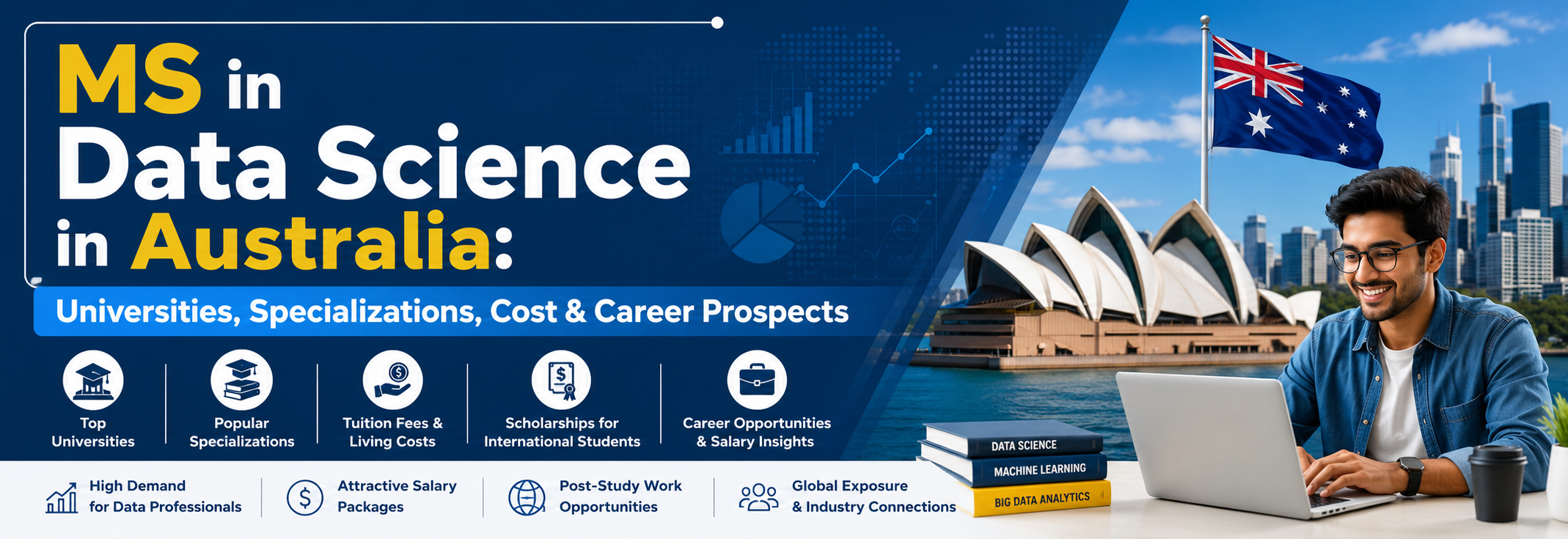
MS in Data Science in Australia: Universities, Specializations, Cost & Career Prospects
Introduction
In today’s data-driven world, organizations rely heavily on data to make informed decisions, optimize operations, and create innovative solutions. As a result, Data Science has emerged as one of the fastest-growing and highest-paying career fields globally. From healthcare and finance to artificial intelligence, cybersecurity, e-commerce, and government sectors, data scientists are helping organizations unlock valuable insights from vast amounts of information.
Australia has become one of the most sought-after destinations for international students pursuing a Master of Science (MS) in Data Science. The country offers world-class universities, industry-focused curricula, cutting-edge research opportunities, and strong employment prospects. With increasing demand for data professionals across industries, studying Data Science in Australia can open doors to exciting global career opportunities.
This comprehensive guide explores everything you need to know about pursuing an MS in Data Science in Australia, including top universities, specializations, eligibility criteria, tuition fees, scholarships, career prospects, and salary expectations.
Why Study MS in Data Science in Australia?
Australia has established itself as a global hub for technology, innovation, and research. The country’s universities consistently rank among the world’s best for Computer Science, Artificial Intelligence, and Data Analytics programs.
Some key reasons to pursue a Master’s in Data Science in Australia include:
1. Globally Recognized Universities
Australian universities are highly regarded worldwide for their academic excellence and industry-driven education. Institutions such as the University of Melbourne, Monash University, University of Queensland, and UNSW offer specialized Data Science programs designed to meet current industry needs.
2. Strong Industry Demand
Data Science professionals are in high demand across Australia. Businesses increasingly rely on analytics, machine learning, cloud computing, and AI technologies, creating excellent job opportunities for graduates.
3. Post-Study Work Opportunities
International students graduating from Australian universities can benefit from post-study work rights, allowing them to gain valuable industry experience after completing their degree.
4. High Earning Potential
Data Science is among Australia’s highest-paying professions. Experienced professionals often earn six-figure salaries, making it a financially rewarding career path.
5. Multicultural Environment
Australia welcomes students from around the world, offering a diverse and inclusive learning environment that enhances personal and professional growth.
What is an MS in Data Science?
A Master of Data Science is a postgraduate degree that combines mathematics, statistics, computer science, machine learning, artificial intelligence, and business intelligence to analyze and interpret complex data.
The program equips students with skills to:
- Analyze large datasets
- Build predictive models
- Develop machine learning algorithms
- Visualize business insights
- Work with big data technologies
- Apply AI-driven solutions
- Solve real-world business challenges
The duration of most Data Science master’s programs in Australia ranges from 1.5 to 2 years depending on academic background and university requirements.
Top Universities for MS in Data Science in Australia
Australia offers numerous prestigious institutions that provide advanced Data Science programs.
1. University of Melbourne
The University of Melbourne offers one of Australia’s most respected Master of Data Science programs. The course focuses on statistics, machine learning, data analytics, and advanced programming skills. Students also complete a major Data Science project, gaining hands-on experience in solving industry challenges.
Key Highlights:
- Duration: 2 Years
- Intake: March
- Strong research opportunities
- Industry-focused curriculum
2. Monash University
Monash University is globally recognized for Data Science and Artificial Intelligence education. Its program provides comprehensive training in data analysis, data management, visualization, machine learning, and ethical data practices.
Key Highlights:
- Duration: 1.5–2 Years
- Top-ranked Data Science faculty
- Industry projects
- ACS-recognized curriculum
3. University of Queensland (UQ)
The University of Queensland offers a highly practical Master of Data Science designed to prepare graduates for careers in technology, consulting, government, and research organizations.
Key Highlights:
- Data Engineering focus
- Advanced analytics training
- Industry-relevant capstone projects
4. University of New South Wales (UNSW)
UNSW’s Master of Data Science and Decisions combines data analytics with business decision-making, making it ideal for students interested in management and strategy alongside technical skills.
Key Highlights:
- Strong business analytics integration
- Industry partnerships
- Research-led teaching
5. RMIT University
RMIT offers a practical and career-oriented Master of Data Science program focusing on data mining, machine learning, visualization, and predictive analytics.
Key Highlights:
- February and July intakes
- Industry collaborations
- Real-world project experience
6. Deakin University
Deakin University emphasizes data organization, analysis, and advanced analytics techniques. The program helps students develop technical expertise while understanding business applications of data.
7. La Trobe University
La Trobe University’s Master of Data Science offers multiple specialization options and focuses on industry-relevant skills highly valued by employers.
Popular Specializations in Data Science
Australian universities allow students to specialize in areas aligned with their career goals.
Machine Learning
Machine Learning focuses on developing algorithms that enable systems to learn from data and make intelligent predictions.
Career Roles:
- Machine Learning Engineer
- AI Specialist
- Data Scientist
Artificial Intelligence
AI specialization explores intelligent systems, deep learning, natural language processing, and computer vision.
Career Roles:
- AI Engineer
- NLP Specialist
- Robotics Developer
Big Data Analytics
Students learn to process and analyze large-scale datasets using technologies such as Hadoop and Spark.
Career Roles:
- Big Data Analyst
- Data Architect
- Analytics Consultant
Business Analytics
This specialization bridges data science and business decision-making.
Career Roles:
- Business Intelligence Analyst
- Strategy Consultant
- Data Analytics Manager
Data Engineering
Focuses on data pipelines, databases, cloud platforms, and infrastructure.
Career Roles:
- Data Engineer
- Cloud Data Architect
- Database Specialist
Statistical Modeling
Students gain advanced knowledge in predictive modeling, probability, and quantitative analysis.
Career Roles:
- Quantitative Analyst
- Research Scientist
- Statistician
Eligibility Requirements for MS in Data Science in Australia
While admission requirements vary by university, most institutions require:
Academic Requirements
- Bachelor’s degree in:
- Computer Science
- Information Technology
- Mathematics
- Statistics
- Engineering
- Related disciplines
Many universities also consider applicants from non-technical backgrounds if they demonstrate quantitative aptitude.
English Language Requirements
International students typically need:
IELTS
- Overall Score: 6.5 – 7.0
TOEFL iBT
- Score: 79 – 100
PTE Academic
- Score: 58 – 65
Requirements may vary depending on the institution.
Additional Documents
Students generally need:
- Academic transcripts
- Degree certificates
- Statement of Purpose (SOP)
- Resume/CV
- Letters of Recommendation
- Passport copy
- English proficiency test scores
Cost of Studying MS in Data Science in Australia
Tuition fees vary depending on the university and program structure.
Average Tuition Fees
International students can expect annual tuition fees ranging between AUD 35,000 and AUD 60,000. Many leading universities fall within this range.
| University | Approximate Annual Tuition Fee (AUD) |
|---|---|
| University of Melbourne | 57,000+ |
| University of Queensland | 58,000+ |
| Monash University | 55,000+ |
| UNSW Sydney | 60,000+ |
| RMIT University | 35,000–45,000 |
| Deakin University | 44,000+ |
| La Trobe University | 34,000–44,000 |
Fees are subject to change by the university.
Cost of Living in Australia
Apart from tuition fees, students should budget for living expenses.
Estimated Annual Living Costs
| Expense | Annual Cost (AUD) |
|---|---|
| Accommodation | 10,000 – 20,000 |
| Food | 4,000 – 8,000 |
| Transport | 1,000 – 2,500 |
| Utilities | 1,500 – 3,000 |
| Personal Expenses | 2,000 – 5,000 |
Overall living costs generally range from AUD 20,000 to AUD 30,000 per year depending on location and lifestyle.
Scholarships for International Students
Many Australian universities offer scholarships to high-achieving international students.
Popular scholarship opportunities include:
- Australia Awards Scholarships
- Destination Australia Scholarship
- University-specific merit scholarships
- Research scholarships
- International Excellence Scholarships
Students are encouraged to check university websites for the latest scholarship offerings.
Career Opportunities After MS in Data Science
The demand for Data Science professionals continues to grow across Australia and globally.
Graduates can find opportunities in:
- Banking and Finance
- Healthcare
- Telecommunications
- Government Agencies
- Artificial Intelligence Companies
- Consulting Firms
- E-Commerce Businesses
- Cybersecurity Organizations
- Technology Startups
Top Job Roles After Graduation
Data Scientist
Analyzes large datasets to uncover patterns, trends, and business insights.
Average Salary:
AUD 115,000–135,000 annually.
Data Analyst
Interprets business data to support strategic decision-making.
Average Salary:
AUD 80,000–110,000 annually.
Machine Learning Engineer
Builds intelligent systems capable of learning from data.
Average Salary:
AUD 110,000–150,000 annually.
Data Engineer
Designs and maintains data infrastructure and pipelines.
Average Salary:
AUD 125,000–145,000 annually.
Business Intelligence Analyst
Creates dashboards and analytical reports to support business growth.
Average Salary:
AUD 90,000–120,000 annually.
AI Engineer
Develops artificial intelligence solutions and automation systems.
Average Salary:
AUD 120,000+ annually.
Future Scope of Data Science in Australia
Australia’s digital transformation initiatives are creating significant demand for professionals with expertise in:
- Artificial Intelligence
- Machine Learning
- Predictive Analytics
- Cloud Computing
- Big Data
- Cybersecurity Analytics
- Business Intelligence
Government agencies, multinational corporations, startups, and research institutions continue to invest heavily in data-driven innovation. Industry reports and university career outcomes indicate strong growth and long-term demand for qualified Data Science professionals.
Suggested Blog: Australia Scholarships for Indian Students: Complete Guide to Funding Your Study Abroad Dream in 2026
Why Choose MDOEC for Your Australian Study Journey?
At MDOEC, we help students achieve their international education goals through personalized counselling and end-to-end support.
Our services include:
- University Selection Guidance
- Course Selection Assistance
- Application Processing
- Scholarship Support
- SOP and Documentation Assistance
- Education Loan Guidance
- Visa Application Support
- Pre-Departure Assistance
Whether you aspire to study Data Science at a leading Australian university or explore other emerging technology programs, MDOEC is committed to helping you make informed decisions and build a successful global career.
Conclusion
An MS in Data Science in Australia is an excellent investment for students seeking a future-proof career in technology, analytics, and artificial intelligence. With globally recognized universities, industry-oriented programs, strong post-study work opportunities, and attractive salary prospects, Australia remains one of the best destinations for aspiring data professionals.
From machine learning and AI to business analytics and big data engineering, Australian universities provide diverse specialization options that align with the evolving needs of the global job market. By choosing the right university and gaining practical industry experience, graduates can position themselves for rewarding careers in one of the world’s most dynamic and rapidly expanding fields.
If you’re ready to take the next step toward a successful Data Science career, connect with MDOEC today and begin your study abroad journey with confidence.
Frequently Asked Questions (FAQs) About MS in Data Science in Australia
1. Is Australia a good destination for an MS in Data Science?
Yes, Australia is one of the top destinations for studying Data Science due to its globally recognized universities, industry-focused curriculum, strong research opportunities, and excellent career prospects. The country also offers post-study work rights, allowing international students to gain valuable professional experience after graduation.
2. What is the duration of an MS in Data Science in Australia?
The duration of a Master’s in Data Science in Australia typically ranges from 1.5 to 2 years, depending on the university, course structure, and the student’s academic background.
3. What are the eligibility requirements for MS in Data Science in Australia?
Most universities require:
- A bachelor’s degree in Computer Science, Information Technology, Mathematics, Statistics, Engineering, or a related field.
- English language proficiency through IELTS, PTE, or TOEFL.
- Academic transcripts.
- Statement of Purpose (SOP).
- Resume/CV.
- Letters of Recommendation (if required).
Some universities may also accept students from non-technical backgrounds with strong quantitative skills.
4. Which are the top universities for Data Science in Australia?
Some of the leading universities offering MS in Data Science include:
- University of Melbourne
- Monash University
- University of Queensland
- UNSW Sydney
- RMIT University
- Deakin University
- La Trobe University
- University of Technology Sydney (UTS)
- Macquarie University
- Swinburne University of Technology
These institutions are known for their strong academic reputation, industry partnerships, and graduate employability.
5. How much does an MS in Data Science cost in Australia?
Tuition fees for international students generally range between AUD 35,000 and AUD 60,000 per year, depending on the university and program. Additional living expenses can range from AUD 20,000 to AUD 30,000 annually.
6. Can I study MS in Data Science in Australia without a Computer Science background?
Yes. Several Australian universities accept students from diverse academic backgrounds such as Mathematics, Statistics, Economics, Engineering, Physics, and Business. Some universities may require applicants to complete prerequisite subjects or foundation modules before starting the program.
7. Are scholarships available for international students pursuing Data Science in Australia?
Yes. International students can apply for various scholarships, including:
- Australia Awards Scholarships
- Destination Australia Scholarships
- International Excellence Scholarships
- University-specific merit scholarships
- Research and postgraduate scholarships
Scholarship eligibility varies by university and academic performance.
8. What are the career opportunities after completing an MS in Data Science in Australia?
Graduates can pursue a wide range of careers, including:
- Data Scientist
- Data Analyst
- Machine Learning Engineer
- Data Engineer
- Artificial Intelligence Engineer
- Business Intelligence Analyst
- Big Data Specialist
- Quantitative Analyst
- Analytics Consultant
- Research Scientist
These roles are in demand across sectors such as finance, healthcare, technology, retail, consulting, and government.
9. What is the average salary after an MS in Data Science in Australia?
Salary packages vary based on experience, location, and employer. Typical salary ranges include:
- Data Analyst: AUD 80,000 – AUD 110,000 per year
- Data Scientist: AUD 115,000 – AUD 135,000 per year
- Data Engineer: AUD 125,000 – AUD 145,000 per year
- Machine Learning Engineer: AUD 110,000 – AUD 150,000 per year
- AI Engineer: AUD 120,000+ per year
Experienced professionals can earn significantly higher salaries.
10. Can international students stay and work in Australia after completing an MS in Data Science?
Yes. International students may be eligible for Australia’s Post-Study Work Visa, which allows graduates to stay and work in Australia after completing their degree. The duration of post-study work rights depends on the qualification level, study location, and current Australian immigration policies.
This opportunity enables graduates to gain industry experience, build professional networks, and potentially pursue long-term career opportunities in Australia.