

Study in Switzerland: Perks, Universities, Courses, Cost & Career Prospects
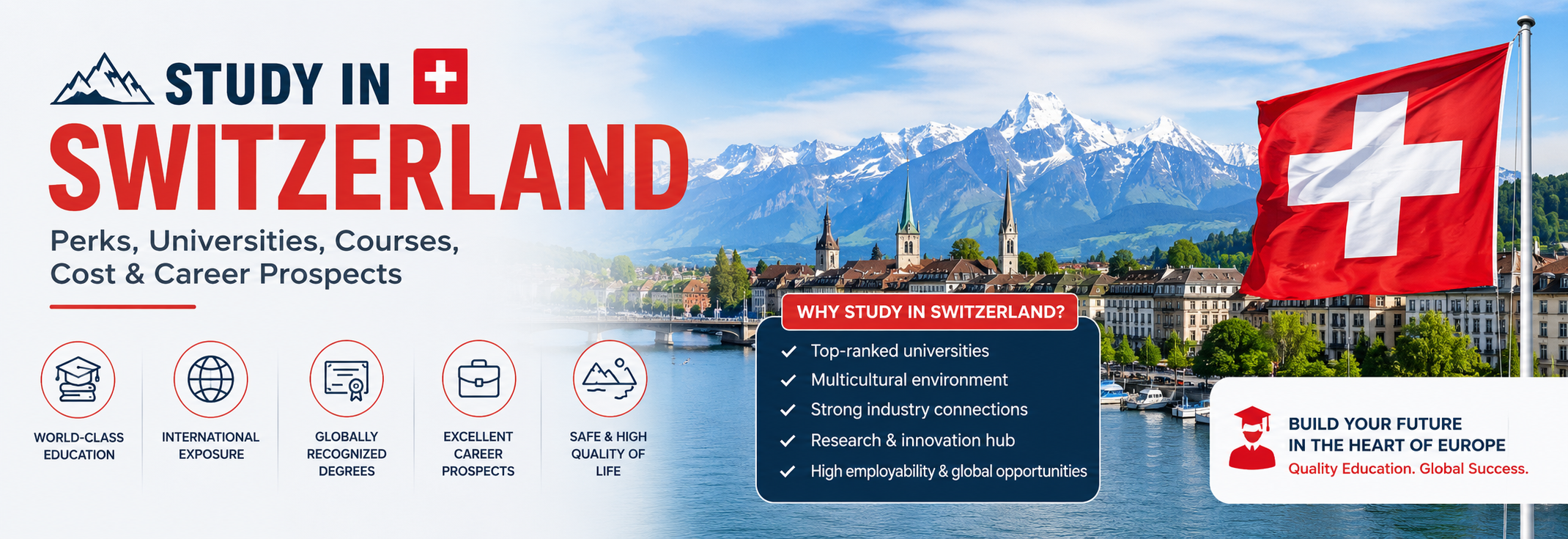
Switzerland doesn’t market itself the way some study-abroad destinations do. It doesn’t need to. Between the Alps, a currency that has held its value for decades, and universities that regularly turn up in the world’s top 20, the country has quietly become one of the most respected — and most expensive — places on earth to get a degree. If you’re weighing Switzerland against the UK, Germany, or the US, this guide walks through what actually matters: the perks, the institutions, the courses worth choosing, the real cost of living there, and what happens to your career once you graduate.
Why Switzerland, Specifically?
Switzerland punches far above its size. With a population smaller than New York City’s metro area, it hosts ETH Zurich, EPFL, the University of Geneva, and the University of Zurich — all fixtures in global top-100 rankings. It’s also home to the headquarters of the UN’s European office, the WHO, the WTO, the Red Cross, and hundreds of multinational corporations from Nestlé to Novartis to Roche. For students in international relations, life sciences, finance, or hospitality, that’s not a coincidence — it’s proximity to the exact organizations they’ll eventually want to work for.
A few things set the country apart from the usual study-abroad shortlist:
Academic prestige without the price tag you’d expect. Public university tuition in Switzerland is startlingly low for the quality on offer — often a fraction of what you’d pay for a comparable degree in the UK, US, or Australia.
Multilingual by design. German, French, Italian, and Romansh are all official languages, and most universities also run a growing number of English-taught programs, especially at the Master’s and PhD level.
Research firepower. Switzerland consistently ranks among the world’s most innovative countries, and its universities are magnets for research funding, patents, and Nobel laureates.
A genuinely central location. Milan, Paris, Munich, and Vienna are all a few hours away by train, making Switzerland a natural base for a student who wants to explore Europe on weekends.
Safety and quality of life. Low crime, reliable public transport, clean cities, and stunning nature within arm’s reach of nearly every campus.
None of this comes cheap, and it’s worth being upfront about that before diving into the details — Switzerland rewards careful financial planning far more than it rewards spontaneity.
The Perks of Studying in Switzerland
1. World-Class Reputation on Your Résumé
A degree from ETH Zurich, EPFL, or the University of St. Gallen carries genuine global weight. Recruiters in engineering, finance, and pharma recognize these names immediately, and Swiss degrees are respected across Europe, North America, and Asia alike.
2. Research Opportunities From Day One
Swiss universities pour a substantial share of GDP into research and development, and that investment trickles down to students. Even at the Bachelor’s level, it’s common to find undergraduates working alongside faculty on funded projects, something that’s harder to access in more crowded, less resourced systems.
3. A Multicultural, Multilingual Environment
International students already make up a significant share of enrollment at institutions like ETH Zurich and EPFL. Classrooms mix German, French, Italian, and English speakers, and many programs actively encourage language learning as part of the experience — a practical skill that pays dividends well beyond graduation.
4. Compact Country, Enormous Access
Switzerland’s rail network is famously punctual, and the country is small enough that a weekend trip from Zurich to Geneva, Lucerne, or Lugano is entirely doable. Combine that with Schengen access and you have a base for exploring the rest of Europe without needing to relocate.
5. Strong Industry Links
Switzerland’s economy runs on precision manufacturing, pharmaceuticals, banking, and international diplomacy — and its universities are built around feeding talent into those industries. Many programs, especially at universities of applied sciences (Fachhochschulen), include mandatory internships or close ties to companies like UBS, Credit Suisse’s successor entities, Novartis, ABB, and Nestlé.
Top Universities to Consider
Switzerland’s higher education system is organized into three main categories: research-focused universities, universities of applied sciences and arts, and universities of teacher education. Here are the names that consistently anchor global rankings and international student interest.
ETH Zurich (Swiss Federal Institute of Technology) — Regularly ranked among the top 10 universities worldwide, ETH Zurich is the country’s flagship for engineering, computer science, physics, and architecture. Albert Einstein studied here, and the university has produced more than 20 Nobel laureates.
EPFL (École Polytechnique Fédérale de Lausanne) — ETH Zurich’s French-speaking counterpart, EPFL is a powerhouse in engineering, life sciences, and computer science, with a sprawling, tech-forward campus on Lake Geneva.
University of Zurich — Switzerland’s largest university, strong across medicine, law, economics, and the humanities, with deep ties to Zurich’s financial sector.
University of Geneva — A hub for international relations, law, and political science, unsurprising given Geneva’s role as a diplomatic capital. It’s also strong in the sciences.
University of Basel — Switzerland’s oldest university, particularly known for life sciences and pharmaceutical research, aided by its location near the headquarters of Novartis and Roche.
University of Bern — Broad and research-intensive, with particular strength in space science (Bernese researchers have contributed to major space missions) and medicine.
University of Lausanne — Strong in social sciences, law, and — through its partnership with EPFL — life sciences and biotechnology.
University of St. Gallen (HSG) — One of Europe’s top business schools, producing a large share of Switzerland’s business and finance leadership. Its management, economics, and law programs are highly regarded.
Universities of Applied Sciences (Fachhochschulen) — Institutions like ZHAW (Zurich University of Applied Sciences) and Lucerne University of Applied Sciences and Arts focus on practice-oriented learning with strong industry placement, ideal for students who want hands-on training over pure theory.
Popular Courses and Fields of Study
Switzerland’s academic strengths map closely onto its economic ones. If you’re deciding what to study, these are the fields where the country genuinely excels — and where a Swiss degree carries the most weight.
- Hospitality and Hotel Management — Switzerland essentially invented the modern hospitality education model, and schools like the École hôtelière de Lausanne (EHL) and Glion Institute of Higher Education are considered global gold standards.
- Engineering and Computer Science — ETH Zurich and EPFL lead here, with particular strength in robotics, AI, mechanical engineering, and civil engineering.
- Finance, Banking, and Economics — Given Zurich and Geneva’s status as banking centers, finance and economics degrees (especially at the University of Zurich and University of St. Gallen) come with direct pipelines into major financial institutions.
- Life Sciences and Pharmaceuticals — Basel’s concentration of pharma giants makes biotechnology, pharmaceutical sciences, and biomedical research especially strong fields.
- International Relations and Political Science — Geneva’s diplomatic ecosystem (UN, WHO, WTO, Red Cross) makes it one of the best places in the world to study international affairs.
- Business Administration and Management — St. Gallen, in particular, has an outsized reputation in European business education.
- Architecture and Design — ETH Zurich’s architecture program is consistently ranked among the world’s best.
Most Bachelor’s programs are taught in German, French, or Italian depending on the region, while Master’s and PhD programs increasingly offer full English-language tracks — Study.eu’s database lists more than 200 English-taught Master’s programs across Swiss universities.
The Real Cost of Studying in Switzerland
Here’s the paradox that catches a lot of students off guard: Switzerland’s tuition is remarkably affordable, but its cost of living is among the highest on the planet. Budgeting for one without the other gives you a badly wrong picture.
Tuition Fees
Public university tuition in Switzerland is set by each individual institution and is low by international standards, even for non-EU/EFTA students:
- ETH Zurich charges CHF 730 per semester (CHF 1,460 per year) for all students, regardless of nationality — remarkable for a university ranked in the global top 10.
- The University of Geneva charges CHF 435 per semester for both Swiss and international students, while the University of Lausanne charges CHF 500 per semester.
- The University of Basel charges CHF 850 per semester regardless of nationality.
- Across public universities generally, tuition ranges between roughly CHF 500 and CHF 5,000 per year.
- Universities of applied sciences (Fachhochschulen) typically charge CHF 700–1,000 per semester, with some charging up to CHF 1,500 per semester for international students.
- Private institutions and specialized programs are a different story entirely — MBA and medicine programs at private institutions can run CHF 30,000–90,000 annually, and private business schools or hospitality institutes commonly charge CHF 15,000 to CHF 30,000 per year.
- PhD study is often the best financial deal of all: doctoral programs are frequently tuition-free or very low-cost at public universities, with funded positions widely available.
Living Costs
This is where the budget really gets tested. Most students should expect to spend around CHF 1,800–2,800 per month on accommodation, food, transportation, health insurance, study materials, and leisure, with significant variation by city. Accommodation is usually the single biggest monthly expense, particularly in Geneva and Zurich where housing demand is very high, typically running CHF 800–1,700 per month depending on the city and housing type.
For visa purposes, non-EU/EFTA students need to show proof of roughly CHF 21,000 per year in available funds, plus mandatory health insurance running around CHF 300–400 per month at student rates. Put together, most independent estimates land on a similar figure: a year at a Swiss public university, tuition and living costs combined, typically costs CHF 22,000–35,000, depending heavily on the city you choose. As one detailed breakdown puts it, tuition is the small part of the equation — living costs are where the real money goes.
Practical budgeting tip: Zurich and Geneva are the most expensive cities to study in; Lausanne, Bern, and Basel offer a somewhat gentler cost of living without sacrificing academic quality. Student housing is limited and competitive everywhere, so applying for accommodation the moment you receive an admission offer is genuinely important — waitlists in Zurich and Geneva can stretch for months.
Scholarships
Government-funded scholarships for international students are more limited in Switzerland than in some other European countries, but they do exist — through the Swiss Government Excellence Scholarships program, individual university funds, and canton-level grants. Given the relatively low tuition fees to begin with, many students find it more realistic to focus fundraising energy on covering living costs rather than tuition.
Visa and Residence Permit Requirements
Switzerland’s immigration process for students depends heavily on where you’re from.
EU/EFTA nationals have it easiest: they register with the local residents’ registration office within 14 days of arrival and receive a residence permit automatically, with no financial proof required beyond showing university enrollment.
Non-EU/EFTA students — including applicants from India, China, the US, and most of the rest of the world — must apply for a residence permit for education (a “B” permit) before entering the country, since Switzerland doesn’t issue a traditional student visa in the conventional sense. Applications go through the local cantonal migration office rather than a central federal agency, and require proof of roughly CHF 21,000 per year in funds, mandatory health insurance, and confirmed university admission; processing typically takes 8–12 weeks.
One requirement worth knowing about upfront: Swiss authorities generally expect students to demonstrate a credible intention to return home after their studies, unless they later qualify for a post-study work or residence option. This is a standard feature of Swiss immigration policy rather than a Switzerland-specific hurdle, but it’s worth having your paperwork and narrative in order.
Working while studying: Students can begin working up to 15 hours per week after their first six months in the country, which helps offset some living costs, though it won’t cover the full budget on its own.
Career Prospects After Graduation
This is arguably where Switzerland makes its strongest case. The country’s unemployment rate is consistently among the lowest in Europe, its salaries are correspondingly high, and its economy runs on exactly the sectors — finance, pharma, engineering, hospitality, and international governance — where its universities specialize.
Post-study job search window. Graduates are generally permitted to stay in the country for a defined period after completing their degree specifically to search for work, after which employment sanctions the transition to a work permit. If you secure a job offer, your employer typically initiates the work permit application on your behalf.
Strong average earnings. Swiss workers earn an average of roughly CHF 6,502 (about USD 7,140) per month, among the highest in the OECD — a meaningful data point when you’re weighing the return on an expensive year of living costs against future earning potential.
Industry demand plays to Swiss academic strengths. Engineers and computer scientists graduating from ETH Zurich or EPFL are recruited directly into companies like Google (which has a major engineering hub in Zurich), ABB, and Logitech. Finance and business graduates from St. Gallen or Zurich move into UBS, Julius Baer, and international banking and consulting. Life sciences graduates from Basel step directly into Novartis, Roche, and a dense cluster of biotech firms. International relations graduates from Geneva have a genuinely rare advantage: the UN, WHO, WTO, and Red Cross are literally down the street.
A springboard into the rest of Europe. Even for graduates who don’t stay in Switzerland long-term, a Swiss degree and the professional network that comes with it travel well — Swiss institutions are respected employers-of-record across the EU, the UK, and North America.
Is Switzerland Worth the Investment?
The honest answer is: it depends on what you study and how deliberately you plan your finances. If you’re pursuing engineering, finance, life sciences, hospitality, or international affairs — the fields Switzerland has built its economy and its universities around — the combination of low tuition, elite academic reputation, and direct pipelines into high-paying employers makes for one of the strongest returns on investment available anywhere in the world. The living costs are real and need to be budgeted for honestly, but they’re offset by tuition fees that are a fraction of what comparable UK or US institutions charge, and by a job market that rewards graduates with some of the highest average salaries on the continent.
For students willing to do the financial planning upfront — securing housing early, budgeting realistically for a CHF 1,800–2,800 monthly cost of living, and choosing a field where Swiss universities genuinely lead — Switzerland offers something rare: elite, internationally respected education, delivered in one of the safest and most naturally beautiful countries on earth, with a career payoff to match.
Conclusion
Switzerland isn’t the cheapest place to study, but it may well be one of the smartest. Low tuition at world-ranked institutions, a stable and multilingual environment, and direct access to some of the highest-paying job markets in Europe combine to make it a genuinely strong long-term investment — provided you go in with a realistic budget and a clear sense of the field you want to build a career in. The application process, from choosing the right university to navigating visa paperwork and financial proof requirements, can feel overwhelming to manage alone. This is where working with an experienced study-abroad partner like MDOEC makes a real difference — from shortlisting universities and courses that match your profile, to guiding you through visa documentation, financial planning, and scholarship applications, so that your move to Switzerland is as smooth as the country’s train timetables. With the right preparation and the right guidance, a Swiss degree can be one of the best decisions you make for your future.
Frequently Asked Questions (FAQs)
1. Is Switzerland expensive to study in? Tuition at public universities is actually quite low by international standards — often between CHF 500 and CHF 5,000 per year. The real expense is the cost of living, which typically runs CHF 1,800–2,800 per month depending on the city.
2. Do I need to know German or French to study in Switzerland? Not necessarily. While most Bachelor’s programs are taught in German, French, or Italian depending on the region, Master’s and PhD programs increasingly offer full English-taught tracks — over 200 English-taught Master’s programs are currently available across Swiss universities.
3. Which are the best universities in Switzerland? ETH Zurich and EPFL consistently rank among the top 10-20 universities in the world, particularly for engineering and sciences. The University of Zurich, University of Geneva, University of Basel, University of Bern, and the University of St. Gallen (for business) are also highly regarded.
4. How much money do I need to show for a Swiss student visa? Non-EU/EFTA students generally need to demonstrate proof of funds of approximately CHF 21,000 per year, along with confirmed university admission and mandatory health insurance.
5. Can international students work while studying in Switzerland? Yes, but not immediately. Students can typically begin working up to 15 hours per week once they’ve completed their first six months in the country.
6. Are scholarships available for international students in Switzerland? Yes, though they’re more limited compared to some other countries. Options include Swiss Government Excellence Scholarships, university-specific funds, and canton-level grants. Because tuition is already low, most students focus their scholarship search on offsetting living costs.
7. What is the best city in Switzerland for students on a budget? Zurich and Geneva are the most expensive. Lausanne, Bern, and Basel offer a comparatively gentler cost of living while still hosting excellent universities.
8. How long can I stay in Switzerland after graduating to look for a job? Graduates are typically given a defined window after completing their degree specifically to search for employment, after which a job offer allows the transition to a Swiss work permit.
9. What are the most in-demand fields to study in Switzerland? Engineering and computer science, finance and banking, life sciences and pharmaceuticals, hospitality management, and international relations are all fields where Swiss universities have a particularly strong reputation and direct industry pipelines.
10. Is a Swiss degree recognized internationally? Yes. Swiss universities are highly respected globally, and degrees from institutions like ETH Zurich, EPFL, and the University of St. Gallen are recognized and valued by employers across Europe, North America, and Asia.
This is a sensitive-to-change topic — tuition fees, visa rules, and cost-of-living figures shift from year to year and by canton. Always verify current numbers directly with your target university and the relevant Swiss cantonal migration office before finalizing your application and budget.