

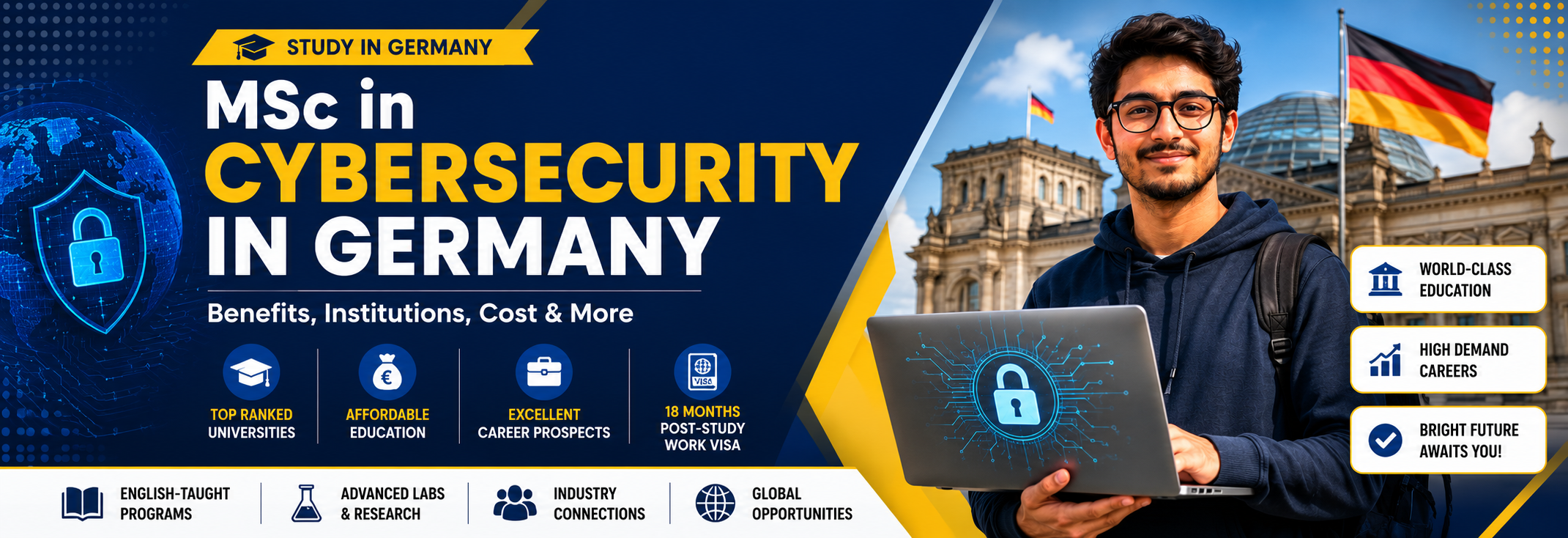
MSc in Cybersecurity in Germany: Benefits, Institutions, Cost & More
As digital transformation accelerates across industries, cybersecurity has become one of the most critical and in-demand fields worldwide. Organizations are investing heavily in protecting their networks, systems, applications, and sensitive data from increasingly sophisticated cyber threats. This growing demand has created excellent career opportunities for cybersecurity professionals across the globe.
Germany, known for its world-class education system, technological innovation, and strong economy, has emerged as one of the top destinations for international students pursuing a Master of Science (MSc) in Cybersecurity. With affordable tuition fees, globally recognized universities, cutting-edge research facilities, and strong employment prospects, Germany offers an ideal environment for students looking to build a successful career in cybersecurity.
In this guide, we’ll explore everything you need to know about pursuing an MSc in Cybersecurity in Germany, including top universities, eligibility requirements, costs, application procedures, and career opportunities.
Table of Contents
- MSc in Cybersecurity in Germany: Key Highlights
- Benefits of Studying MSc in Cybersecurity in Germany
- Popular Institutions for MSc in Cybersecurity in Germany
- Eligibility Criteria for an MSc in Cybersecurity in Germany
- Application Process for MSc in Cybersecurity in Germany
- Global Career Prospects after a MSc in Cybersecurity in Germany
- FAQs
MSc in Cybersecurity in Germany: Key Highlights
Germany has become a leading destination for international students pursuing technology-related degrees due to its exceptional education quality and affordable study options.
| Particulars | Details |
|---|---|
| Degree | MSc / MS in Cybersecurity |
| Duration | 18–24 Months |
| Language of Instruction | English (Most Programs) |
| Tuition Fees | €0 – €25,000 per Year |
| Living Costs | €850 – €1,200 per Month |
| Intakes | Winter and Summer |
| Post-Study Work Visa | Up to 18 Months |
| Part-Time Work Rights | Allowed During Studies |
| Average Graduate Salary | €50,000 – €70,000+ |
| Popular Study Cities | Berlin, Munich, Aachen, Darmstadt, Saarbrücken |
Cybersecurity master’s programs in Germany focus on practical learning, research, and industry collaboration. Students gain expertise in information security, cryptography, ethical hacking, network security, digital forensics, cloud security, and cyber risk management.
Benefits of Studying MSc in Cybersecurity in Germany
Germany offers numerous advantages that make it one of the best destinations for cybersecurity education.
1. World-Class Universities
German universities are globally recognized for excellence in engineering, technology, and computer science. Students benefit from advanced learning environments, expert faculty members, and modern research facilities.
Many cybersecurity programs are designed in collaboration with industry leaders to ensure graduates are job-ready from day one.
2. Affordable Education
One of the biggest attractions of studying in Germany is affordability.
Most public universities charge little to no tuition fees, requiring students to pay only a semester contribution. Compared to countries such as the USA, UK, and Australia, Germany provides exceptional value for money.
Tuition Fee Comparison
| Country | Average Tuition Fees |
|---|---|
| Germany | €0 – €500 (Public Universities) |
| UK | €15,000 – €35,000 |
| USA | €20,000 – €50,000 |
| Australia | €25,000 – €45,000 |
This allows students to earn a globally respected degree while minimizing educational expenses.
3. High Demand for Cybersecurity Professionals
The cybersecurity industry is experiencing unprecedented growth due to increasing cyber threats and digital transformation initiatives.
Organizations across sectors including banking, healthcare, automotive, government, telecommunications, and e-commerce require skilled cybersecurity experts to protect critical systems and sensitive data.
This demand translates into strong job prospects and competitive salaries for graduates.
4. Strong Industry Connections
German universities maintain close partnerships with multinational corporations, research institutions, and technology companies.
Students often gain access to:
- Industry internships
- Research collaborations
- Corporate projects
- Career fairs
- Networking opportunities
- Graduate recruitment programs
These experiences help students build valuable industry connections before graduation.
5. Access to Cutting-Edge Research
Germany is known for innovation and technological advancement.
Cybersecurity students frequently participate in research related to:
- Artificial Intelligence Security
- Blockchain Security
- Cloud Security
- Quantum Cryptography
- Secure Software Development
- Digital Forensics
Research opportunities enhance technical skills and open pathways to specialized careers.
6. Excellent Post-Study Work Opportunities
International graduates can remain in Germany for up to 18 months after completing their degree to search for employment.
This generous post-study work period significantly improves employment prospects and provides graduates with time to secure relevant positions in the German job market.
7. International Career Recognition
A German master’s degree is recognized and respected globally.
Graduates can pursue career opportunities not only in Germany but also across Europe, North America, Asia-Pacific, and the Middle East.
8. High Quality of Life
Germany offers:
- Excellent public transportation
- Affordable healthcare
- Safe cities
- Multicultural communities
- Strong economy
- Student-friendly environment
Students enjoy a high standard of living while pursuing their academic goals.
Popular Institutions for MSc in Cybersecurity in Germany
Germany is home to several prestigious universities offering specialized cybersecurity programs.
1. Saarland University
Saarland University is widely recognized for its strong focus on cybersecurity research and innovation.
Program Highlights
- MSc in Cybersecurity
- English-taught curriculum
- Strong research orientation
- Collaboration with cybersecurity research centers
- Affordable education
The university is considered one of Germany’s leading institutions for cybersecurity studies.
2. Technical University of Munich (TUM)
The Technical University of Munich consistently ranks among the best universities in Europe.
Program Highlights
- Strong emphasis on IT security
- Excellent research opportunities
- Industry partnerships
- Access to advanced laboratories
- High graduate employability
Students benefit from Munich’s thriving technology ecosystem.
3. RWTH Aachen University
RWTH Aachen is renowned for engineering and computer science education.
Program Highlights
- Cybersecurity specialization options
- Research-focused curriculum
- Practical project work
- Industry collaborations
- Strong technical foundation
Graduates are highly sought after by employers across Europe.
4. Technical University of Berlin
Located in Germany’s startup capital, TU Berlin provides students with exceptional networking opportunities.
Program Highlights
- Industry-oriented learning
- Innovative research projects
- Access to Berlin’s technology sector
- Strong international community
5. Brandenburg University of Technology
The university offers specialized cybersecurity education with a practical approach.
Program Highlights
- Applied cybersecurity curriculum
- Engineering-based learning
- Industry-relevant skills development
- Affordable study costs
6. University of Potsdam (Hasso Plattner Institute)
The Hasso Plattner Institute is one of Germany’s most respected technology institutions.
Program Highlights
- Cybersecurity Engineering specialization
- Focus on software security
- Research-intensive learning
- Strong industry partnerships
7. SRH University
SRH University offers career-oriented cybersecurity programs designed to meet modern industry requirements.
Program Highlights
- English-medium instruction
- Industry-focused curriculum
- Practical learning approach
- Multiple campus locations
Eligibility Criteria for an MSc in Cybersecurity in Germany
Admission requirements may vary depending on the university; however, most institutions follow similar criteria.
Academic Requirements
Applicants generally need:
- A Bachelor’s degree in:
- Computer Science
- Information Technology
- Cybersecurity
- Software Engineering
- Information Systems
- Related technical disciplines
Most universities prefer applicants with:
- Strong academic performance
- Programming knowledge
- Networking fundamentals
- Mathematics background
English Language Requirements
Since most cybersecurity programs are taught in English, international students must demonstrate English proficiency.
Accepted Tests
| Test | Typical Requirement |
|---|---|
| IELTS | 6.0 – 6.5 |
| TOEFL iBT | 80 – 90 |
| PTE Academic | 58 – 65 |
Some universities may waive language requirements if previous education was completed in English.
Required Documents
Applicants typically need:
- Academic transcripts
- Degree certificate
- Statement of Purpose (SOP)
- Curriculum Vitae (CV)
- Letters of Recommendation (LORs)
- English language test scores
- Passport copy
- Passport-size photographs
Certain universities may require additional documentation depending on the program.
Application Process for MSc in Cybersecurity in Germany
The application process for German universities is generally straightforward but requires careful planning.
Step 1: Research Universities
Start by identifying universities that align with your:
- Academic interests
- Budget
- Career goals
- Preferred city
- Specialization preferences
Step 2: Check Eligibility Requirements
Review the admission criteria for each university, including academic qualifications and language requirements.
Step 3: Prepare Required Documents
Gather and organize all required documentation, including transcripts, SOP, CV, recommendation letters, and test scores.
Step 4: Submit Applications
Applications can usually be submitted through:
- University admission portals
- Uni-Assist platform
- Direct university application systems
Ensure all documents are submitted before the application deadline.
Step 5: Receive Admission Decision
Universities evaluate applications and issue:
- Conditional Offers
- Unconditional Offers
Successful applicants can then proceed with enrollment formalities.
Step 6: Apply for a German Student Visa
International students must apply for a student visa after receiving their admission letter.
Common requirements include:
- Admission offer letter
- Valid passport
- Proof of financial resources
- Health insurance
- Visa application documents
Step 7: Travel and Complete Enrollment
Once the visa is approved, students can:
- Arrange accommodation
- Travel to Germany
- Complete university registration
- Begin their academic journey
Global Career Prospects after a MSc in Cybersecurity in Germany
Cybersecurity professionals are among the most sought-after technology specialists worldwide.
Graduates from German universities enjoy strong employment opportunities due to increasing demand for cybersecurity expertise across industries.
Popular Career Paths
Cybersecurity Analyst
Responsible for monitoring systems, identifying threats, and responding to security incidents.
Information Security Manager
Develops and manages organizational security strategies and compliance frameworks.
Ethical Hacker
Conducts penetration testing and identifies vulnerabilities before malicious attackers can exploit them.
Security Consultant
Provides expert advice on cybersecurity strategies, risk management, and compliance requirements.
Digital Forensics Investigator
Analyzes cybercrime incidents and investigates security breaches.
Cloud Security Engineer
Designs and implements security solutions for cloud environments.
Cyber Risk Analyst
Assesses cybersecurity risks and develops mitigation strategies for organizations.
Suggested Blog Germany Student Visa 2026–2027: Complete Requirements, Application Process and More
Average Salary Expectations
| Job Role | Average Annual Salary |
|---|---|
| Cybersecurity Analyst | €50,000+ |
| Security Consultant | €55,000+ |
| Information Security Manager | €65,000+ |
| Cloud Security Engineer | €60,000+ |
| Cyber Risk Analyst | €55,000+ |
| Ethical Hacker | €55,000+ |
Salary levels vary based on experience, location, specialization, and employer.
Top Recruiters
Cybersecurity graduates frequently secure positions with:
- SAP
- IBM
- Siemens
- Bosch
- Deutsche Telekom
- Airbus
- Deloitte
- Accenture
- Capgemini
- BMW
- Volkswagen
- Allianz
The continued growth of digital technologies ensures long-term career stability and advancement opportunities.
Trusted Resources for Students Pursuing an MSc in Cybersecurity in Germany
Before applying for an MSc in Cybersecurity in Germany, students should consult official university websites, government portals, and educational resources to obtain accurate information about admission requirements, tuition fees, scholarships, student visas, program curricula, and career opportunities. Germany offers world-class cybersecurity education through renowned universities and research institutions, making it one of the most attractive destinations for international students.
| Resource | Purpose | Official Website |
|---|---|---|
| DAAD (German Academic Exchange Service) | Explore master’s programs, scholarships, admission requirements, and study opportunities across Germany. | DAAD (German Academic Exchange Service) |
| DAAD International Program Database | Search English-taught MSc Cybersecurity and Computer Science programs offered by German universities. | DAAD International Program Database |
| Saarland University – MSc Cybersecurity | Official program information including curriculum, eligibility criteria, and application deadlines. | Saarland University – MSc Cybersecurity |
| Saarland University Study Portal | Detailed information about the MSc Cybersecurity degree and university admissions. | Saarland University Study Portal |
| Technical University of Munich (TUM) | Information about IT security, privacy, and computer science-related master’s programs. | Technical University of Munich (TUM) |
| RWTH Aachen University | Explore cybersecurity-related master’s specializations and research opportunities. | RWTH Aachen University |
| Hasso Plattner Institute (HPI) | Learn about Cybersecurity Engineering programs, research projects, and innovation initiatives. | Hasso Plattner Institute (HPI) |
| Study in Germany (Official Government Portal) | Official guidance on studying in Germany, visas, accommodation, and student life. | Study in Germany (Official Government Portal) |
| Make it in Germany | Information about post-study work opportunities, employment prospects, and residence permits. | Make it in Germany |
| Uni-Assist | Centralized application platform used by many German universities for international admissions. | Uni-Assist |
Why These Resources Matter
These official resources can help students:
- Compare MSc Cybersecurity programs across Germany.
- Understand admission and language requirements.
- Explore scholarship and funding opportunities.
- Learn about student visa procedures.
- Research living costs and accommodation options.
- Discover internship and post-study work opportunities.
- Stay updated with university application deadlines.
By relying on official sources, students can make informed decisions and ensure a smoother application process for their MSc in Cybersecurity in Germany.
Conclusion
An MSc in Cybersecurity in Germany offers an exceptional combination of academic excellence, affordability, research opportunities, and global career prospects. With internationally recognized universities, advanced cybersecurity programs, strong industry partnerships, and a thriving technology ecosystem, Germany has become one of the best destinations for aspiring cybersecurity professionals.
Whether your goal is to work as a Cybersecurity Analyst, Ethical Hacker, Security Consultant, or Information Security Manager, Germany provides the education, practical experience, and industry exposure needed to succeed in this rapidly evolving field.
For students seeking expert guidance on university selection, applications, admission requirements, and student visa processes, MDOEC can help simplify your journey and support your dream of studying in Germany.
FAQs
Is Germany a good destination for an MSc in Cybersecurity?
Yes, Germany is one of the top destinations for cybersecurity studies due to its world-class universities, affordable education, strong research infrastructure, and excellent career opportunities.
How long does an MSc in Cybersecurity in Germany take?
Most programs typically last between 18 and 24 months.
Can international students study Cybersecurity in Germany in English?
Yes, many universities offer fully English-taught MSc Cybersecurity programs for international students.
What is the average salary after completing an MSc in Cybersecurity in Germany?
Graduates can earn between €50,000 and €70,000+ annually depending on their role, employer, and experience.
Is IELTS required for admission?
Most universities require proof of English proficiency through IELTS, TOEFL, or equivalent tests. Some institutions may offer waivers under specific circumstances.
Can I stay in Germany after graduation?
Yes, international students can stay in Germany for up to 18 months after graduation to search for employment.
Are cybersecurity professionals in demand in Germany?
Absolutely. Germany faces a growing demand for cybersecurity experts across industries such as banking, healthcare, manufacturing, government, and technology.